COURSE 01 / 04 AVAILABLE NOW PRE-SOLO TRAINING

Learn to Fly Solo.

The Program

A CFI-designed mixed reality flight training program. 40+ hours of deep practice across 65 lessons and 10 modules — structured to take aspiring pilots from first-time to solo-ready.

001 How to Enroll

Three ways to train with us.

Self-Study gives you the complete program. Coached adds CFI feedback at the critical moments. À la carte lets you add hours whenever you need them.

Self-Study
$ 499

A complete VR flight training program. Everything you need to train to solo-ready on your own.

Includes
  • 65 video lessons across 10 modules
  • 20 pre-built MSFS 2024 mission files
  • Custom aircraft checklist
  • Mission workbook (yours to keep)
  • 12 months of course platform access
À la carte coaching
$ 125 / hour

Add coaching to your Self-Study enrollment, or get additional help beyond what's included in the Coached tier.

How it works
  • Fly a flight of your choosing, recorded with the flight recorder
  • Upload the recording and schedule a 1-hour live review session
  • Available to any enrolled Accelerated Pilot student
  • Purchase individual sessions whenever you need them
002 What's Inside

Four components.
One complete training program.

Learn to Fly Solo is built on the same four-component structure as every course in the Accelerated Pilot curriculum. You learn the rhythm once — then apply it through your entire training arc.

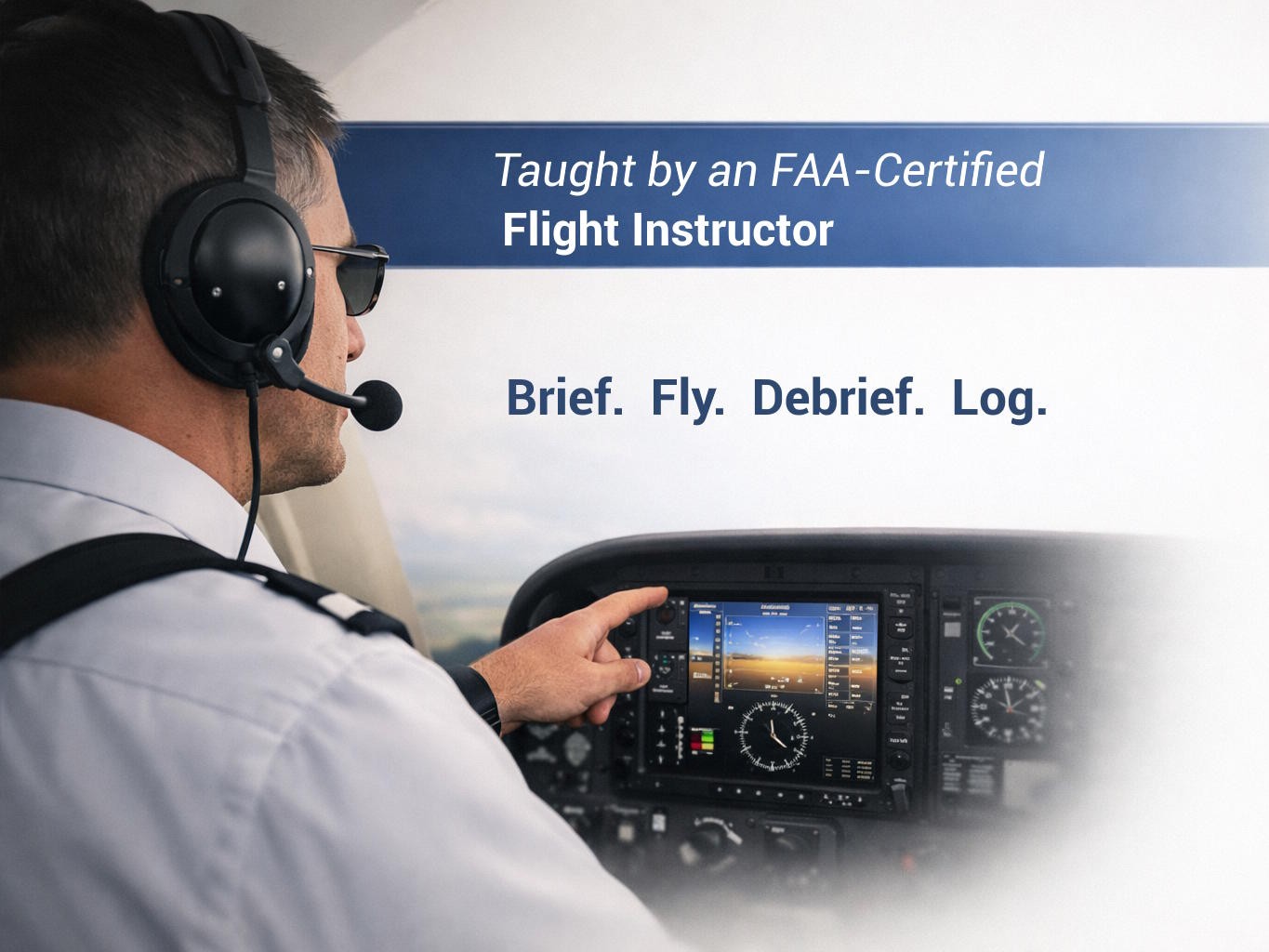
An FAA-certified flight instructor in headset and uniform interacting with a Garmin PFD in the cockpit, captioned 'Brief. Fly. Debrief. Log.'
Instruction

65 Video Lessons

Taught by an FAA-certified flight instructor.

Every skill in the syllabus has a dedicated video lesson. Clear explanation of the maneuver, the sight picture, the technique, and the standards you'll be evaluated against. Focused instruction, organized into 10 progressive modules from hardware setup through emergency procedures.

Lessons follow the brief-fly-debrief-log structure in-aircraft flight training uses. Watch the brief. Fly the maneuver. Debrief your performance. Log the session. Move to the next lesson.
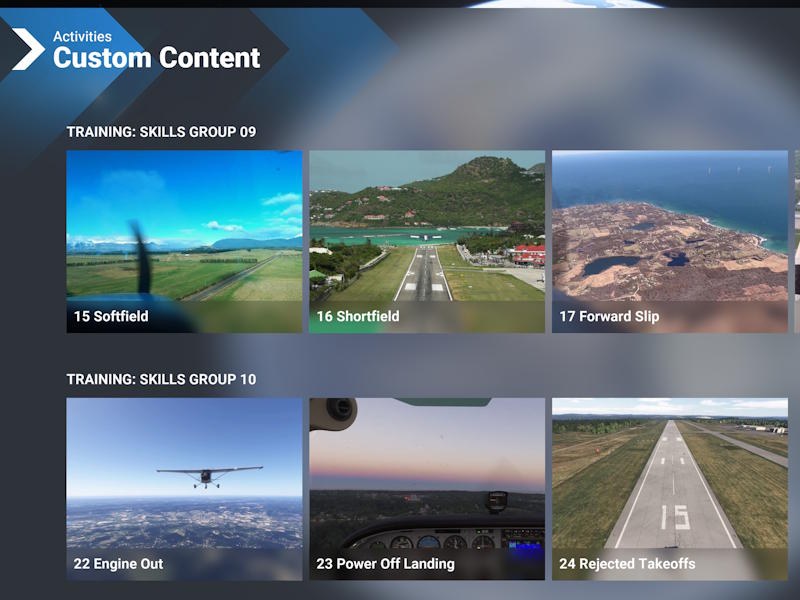
The MSFS 2024 Activities screen showing custom Accelerated Pilot mission tiles including Softfield, Shortfield, Forward Slip, Engine Out, Power Off Landing, and Rejected Takeoffs
Practice

20 Pre-Built MSFS 2024 Mission Files

Pre-built scenarios covering every flight lesson.

Every flight lesson includes a pre-built mission — aircraft configured, weather set, starting position placed, objective defined. You load the mission and fly. No guessing what to practice.

The FAA frames scenario-based training as the preferred way to teach pilots how to think — not just how to perform tasks. Learn to Fly Solo is built around that principle. Each mission places you at the edge of your current ability and asks you to operate the aircraft in a specific context that will come up in in-aircraft flight training.

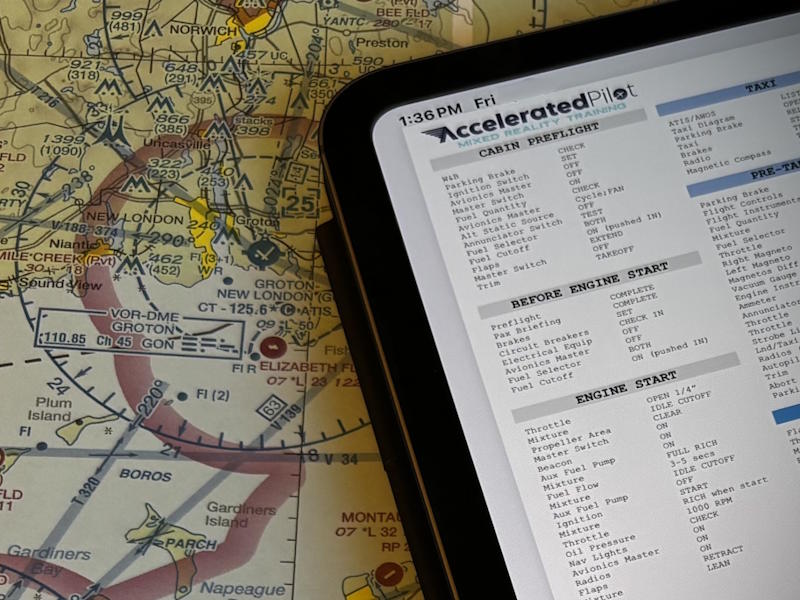
The Accelerated Pilot custom aircraft checklist displayed on an iPad over a sectional chart
Habit

Custom Aircraft Checklist

Printable, laminatable, built for the course aircraft.

Pilots use checklists. Every flight. Every time. Learn to Fly Solo includes a purpose-built checklist covering preflight, before-engine-start, runup, pre-takeoff, and shutdown procedures — the same sequences you'll use in-aircraft.

The checklist isn't a reference document. It's a habit-builder. By the time you transition to in-aircraft training, using a checklist will be automatic.

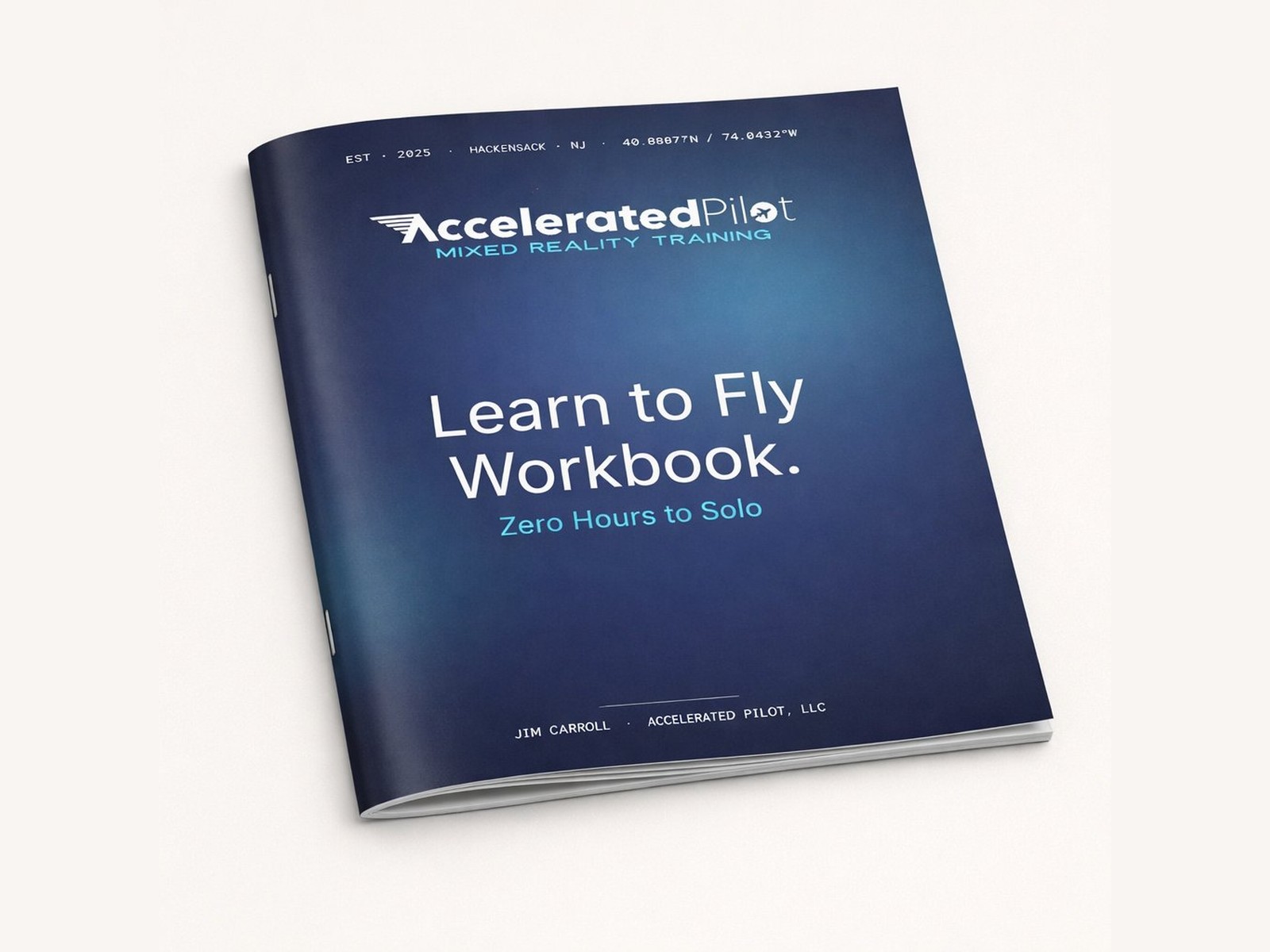
The Learn to Fly Workbook — a 40-page downloadable training companion
Record

Mission Workbook

Where practice becomes training.

For every lesson, the workbook provides a brief, the achievement standards you're practicing toward, and space to record what you observed, what you learned, and what you want to work on next.

By the end of the course, you've built a complete training record — the kind of documented progression student pilots build with their CFIs in in-aircraft training. You'll know exactly where you stand on every skill in the syllabus.

003 The Syllabus

10 modules.
65 lessons.
From setup to solo-ready.

Every module builds on the last. Three Phase Checks and a Graduation Phase Check mark the milestones where Coached students meet live with their CFI.

Phase Check (Coached tier)
Graduation Phase Check (Coached tier)
  1. M1

    Course Intro 10 lessons

    Hardware setup, VR configuration, MSFS 2024 optimization, and how to get the most out of the program. By the time you finish Module 1, your computer is dialed in and you're ready to train.

  2. M2

    The Fundamentals

    Straight and level, trim, turns, climbs and descents, coordination. The foundational skills every pilot builds on.

  3. M3

    Preflight

    Walkaround, systems checks, engine start, taxi procedures, runup, and pre-takeoff checklists. The preparation that happens before every flight.

  4. M4

    Slow Flight, Stalls & Spins

    Slow flight regime, power-on and power-off stalls, spin awareness and recovery. The maneuvers that teach you to recognize and respect the edge of the flight envelope.

  5. M5

    Ground Reference Maneuvers VFR Maneuvers Phase Check

    Turns around a point, rectangular pattern, S-turns across a road. The maneuvers that teach you to manage wind and maneuver the aircraft relative to the ground.

  6. M6

    Traffic Patterns

    Pattern entries, downwind/base/final, go-arounds, and non-towered radio procedures per FAA AC 90-66. The skills that integrate you into an airport environment.

  7. M7

    Landing and Shutdown Pattern and Landing Phase Check

    Normal landings, rollout, taxi back, shutdown flows, securing the aircraft. Completing the flight.

  8. M8

    Crosswind Landings

    Wind correction, slip techniques, go/no-go decisions. The skill that most distinguishes safe pilots from lucky ones.

  9. M9

    Performance Takeoffs and Landings Performance Maneuvers Phase Check

    Short field and soft field techniques, forward slips, and no-flap landings. The performance maneuvers every Private Pilot applicant is evaluated on.

  10. M10

    Emergency Procedures Graduation Phase Check

    Engine failure, simulated engine-out, emergency descents, forced landings, rejected takeoffs. The scenarios you hope you'll never face — and the training that makes sure you can if you do.

004 How Coaching Works

CFI feedback on the flights you fly.

Whether you're in the Coached tier or adding à la carte sessions, every coaching interaction follows the same structured workflow — built around your recorded flights.

  1. 01

    Complete the module.

    Work through the video lessons, fly the scenarios, and document your progress in the workbook.

  2. 02

    Fly the Phase Check mission.

    At specific checkpoints in the syllabus, your CFI assigns a prescribed flight designed to test the skills you've built so far. Record it with the flight recorder.

  3. 03

    Submit your recording.

    Use the contact form on our Contact page to schedule your session. Enrolled students receive direct submission instructions in their welcome email.

  4. 04

    Your CFI reviews your flight.

    Before your scheduled session, an Accelerated Pilot FAA-certified instructor reviews your recording in detail — noting specific timestamps, technique observations, and areas to address.

  5. 05

    Meet live for your debrief.

    Join a one-hour live video call with your CFI. Walk through the flight together, hear feedback in context, and ask questions.

  6. 06

    Apply the feedback.

    Return to the syllabus with focused practice goals. By the next Phase Check, you'll see the difference.

The Graduation Phase Check adds a one-hour ground review before the flight portion — oral-style evaluation of the aeronautical knowledge required for your Private Pilot certificate. This hour is delivered by your CFI and is FAA-loggable ground training under 14 CFR Part 61. You'll receive a logbook endorsement.

The Graduation Phase Check requires completion of an online Private Pilot ground school prior to scheduling. We don't teach ground school content — it's covered by several reputable providers we can recommend.

005 Meet Your Instructor
Jim Carroll, founder of Accelerated Pilot and FAA-certified flight instructor, pictured in an aircraft cockpit

Built by a flight instructor, for the next generation of pilots.

Learn to Fly Solo was designed by Jim Carroll — founder of Accelerated Pilot and an FAA-certified flight instructor. Jim built the Learn to Fly Solo syllabus to translate the structured, deep-practice methodology he uses with his in-aircraft students into a VR-native training program.

Every lesson in Learn to Fly Solo is taught by a CFI. Every coaching session is delivered by an Accelerated Pilot FAA-certified instructor. This isn't a program designed by marketers and narrated by voice actors. It's an FAA-certified flight instructor teaching flight training — delivered in the medium that makes deep practice possible.

006 Why This Works

This isn't a game. It's training.

01

Deep Practice

Every lesson is designed for focused repetition at the edge of your ability. You don't just watch a video — you practice the skill until you meet the achievement standard, then you practice it again. Skill is built through deliberate effort, not passive exposure.

02

Scenario-Based

The FAA's preferred training approach. Every mission places you in a specific context and asks you to operate as a pilot, not just perform a task. You learn to think like a pilot, not just move controls like one.

03

CFI-Delivered

Every lesson is designed and taught by an FAA-certified flight instructor. Every coaching session is delivered by an Accelerated Pilot FAA-certified instructor. The curriculum is disciplined, consistent, and grounded in how in-aircraft flight training is taught.

007 Who This Is For

A path for anyone serious about becoming a pilot.

IF YOU WANT TO FLY
  • You want to become a Private Pilot — for a career in aviation, a lifelong dream, or because flight has always called to you
  • You're serious about training — willing to treat VR as practice, not gaming
  • You want to arrive at your first in-aircraft lesson already knowing how to fly
  • You have access to a VR headset and a PC that can run MSFS 2024
IF YOU'RE SUPPORTING SOMEONE WHO WANTS TO FLY
  • You're a parent of an aspiring young pilot, or a partner supporting someone's dream
  • You want a legitimate, structured training program — not a video game
  • You want to understand where the money is going and what they're learning
  • You want the safety, credibility, and rigor of in-aircraft flight training methodology
THIS MIGHT NOT BE THE RIGHT FIT IF
  • You're looking for a casual flight simulator hobby
  • You don't have access to a VR headset or a PC capable of running MSFS 2024
  • You're looking for a replacement for in-aircraft flight training (no home VR setup is FAA-approved for logging flight time — Learn to Fly Solo prepares you to excel at the training that is)
008 The Economic Argument

Aircraft time is the most expensive hour in pilot training.

At $300 per hour nationally for plane and instructor, flight training is the most expensive phase of pilot training — and most students take 30+ hours above the FAA minimum to reach their checkride.

Learn to Fly Solo gives you 40+ hours of structured practice before your first in-aircraft lesson. You don't arrive as a beginner who's never flown. You arrive as a student who's already flown the patterns, practiced the stalls, and executed the landings — in VR, under the same standards you'll be evaluated against.

Will you save money? Honestly, it depends on you. Some students will save meaningfully. Others will pay closer to the minimum from day one. What's certain is this: the students who show up prepared spend fewer lessons relearning what they forgot, and more lessons building toward their checkride.

The math on one $499 course versus the price of aircraft time isn't complicated.

OUR GUARANTEE

14 days to decide this is right for you.

If Learn to Fly Solo isn't what you expected, email us within 14 days of your enrollment for a full refund — no questions asked, provided you haven't completed more than 25% of the course.

We'd rather you be certain this is right for you than be stuck with a course that doesn't fit. You can read the complete Refund Policy for the full terms.

Ready to start

Ready to start flying?

40+ hours in the sim. 65 lessons. 10 modules. One outcome: solo-ready.